Guide For Taking the Shortest Path Between Two Points Luiza Sigulem
Dates : Samedi 24 janvier 2026 - Samedi 28 février 2026
Vernissage : Vernissage Samedi 24 janvier 2026 - 14:00
Adresse : Ateliê397, Travessa Dona Paula, 119A – Higienópolis, São Paulo, 01239-050 São Paulo
Ateliê397
Travessa Dona Paula, 119A – Higienópolis, São Paulo
São Paulo-SP
01239-050
Brésil
Description, horaires...
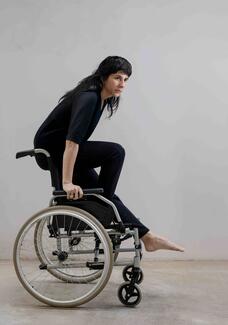
Artist Luiza Sigulem opens her second solo exhibition, Guide For Taking the Shortest Path Between Two Points, scheduled to open on January 24, 2026, at Ateliê397 in São Paulo. Bringing together a unique set of works, the exhibition, curated by Juliana Caffé, strains the relationship between body, architecture and time, proposing displacement as an operation of adjustment and critical reflection.
The project takes instability as a condition that reorganizes the relationship between body and architecture, producing a sense of time that does not coincide with the logic of efficiency. In line with Crip theory (a term reappropriated from cripple, which refers to practices that displace the “standard body”) and the concept of crip time — a temporality that welcomes pauses, variable rhythms, and non-alignment with the productivity clock —, Sigulem's work affirms difference not as an exception, but as a method.
“Throughout my process, the lack of accessibility manifested itself in the time needed to deal with small and large obstacles and in the attention required by minimal adjustments that accumulated almost imperceptibly,” says the artist. "This experience shifted the idea of efficiency and brought my production closer to a notion of expanded time, in which the rhythm of the body does not coincide with the normative expectation of capitalist reproduction. It is in this mismatch that my work is constructed."
Incorporating video performances, interventions, and a sculpture in dialogue with photography for the first time, the project marks a moment of expansion in the artist's career and places accessibility at the center of aesthetic and poetic construction. It also highlights the invisibility of a significant portion of the population: according to data from PNAD Contínua 2022 (IBGE), Brazil has about 18.6 million people with disabilities, of whom approximately 3.4 million have physical disabilities in their lower limbs, a contingent that faces the architectural barriers discussed in the exhibition on a daily basis.
Architecture and poetics: an exhibition inversion
The project emerges from an unavoidable fact of the São Paulo context: the structural difficulty of finding exhibition spaces capable of accommodating the artist's research in a consistent way with her concerns. Faced with the lack of viable alternatives and institutional deadlines, the exhibition embraced this limitation as part of the project, transforming it into a field of reflection.
“The choice of Ateliê397 as the venue for the exhibition responds to this context. As an independent space, it offers conceptual openness and a real field of negotiation for the construction of this project,” comments curator Juliana Caffé. “Located on Travessa Dona Paula, in an area marked by important cultural facilities that are equally limited in terms of accessibility, the space is incorporated by the exhibition as an active element, ceasing to operate as a neutral support to integrate architecture, circulation, and surroundings into the proposed field of discussion.”
Given the architectural limitations of the Ateliê, Sigulem does not treat the lack of accessibility as an obstacle to be corrected, but as a condition to be critically addressed. The exhibition design operates a deliberate inversion: instead of adapting the space to a normative standard, it is the public that is led to recalibrate their bodies when faced with narrowed passages and displaced scales.
In this sense, the exhibition presents an installation, developed by the artist in collaboration with Messina | Rivas, which brings together accessibility and permanence devices designed as an integral part of the work. The intervention reorganizes the reception area: the door and doorframe have been moved to allow full opening (180°); benches and stools have been distributed to encourage rest; and cushions on the outdoor benches extend the experience to the surroundings.
The radical nature of the proposal is reflected in the institutional occupation: the side of the staircase, which leads to a second floor inaccessible to people with disabilities, has been converted into a small library of Crip theory. "During the exhibition, Ateliê397 agreed to render the upper floor inoperable, suspending its use as a projection room to make the architectural limitation explicit rather than hide it. And, as an external development, the project includes the production and donation of custom-made mobile ramps for neighboring cultural spaces in the village, prompting the circuit to collectively think about its access conditions," points out Caffé.
The project aligns with contemporary debates that seek visibility without capture, where the work operates through sensation, rhythm, and micro bodily events that cannot be reduced to an “explanatory” image or easily consumable content. This approach recognizes access as aesthetics and disability as a diagnosis of space and norms. In this way, curatorship and exhibition design become an active part of the work. Braille texts, audio description, and photo-tactile accompany the exhibition, whose operation and mediation incorporate the hiring of people with disabilities, respecting different circulation periods.
In addition, all the devices on display were made with simple, low-cost materials, confirming the possibility of building accessible spaces even in architectures that do not fully meet legal standards.
Body in negotiation: video, sculpture, and photography
While in previous works Sigulem invited others to adjust to certain scales, such as in the series Jeito de Corpo (2024), in this solo exhibition the artist places her own body at the center of the experience. Different works explore this shift in perspective, sometimes proposing situations in which the audience is led to reorient their spatial perception, sometimes accompanying the artist in gestures of continuous negotiation with space.
The videos are based on reinterpretations of historical performances, performed by the artist's body and inflected by issues of gender and power. The actions do not seek fidelity to the original gesture, but operate as a situated translation, in which each movement bears the mark of a necessary adjustment. The camera follows the process without correcting the deviation, allowing the failure and effort to remain visible.
This is the case with the new series Rampas (2025), a set of twenty photographs derived from the video performance Painting (Retoque) (based on Francis Alÿs). In the video, the artist marks with yellow paint points on the streets of São Paulo where access ramps should exist, highlighting the lack of accessibility in the urban landscape. The photographs isolate these gestures and traces, transforming the performative action into images that record the friction between body, city, and infrastructure.
By adopting the height of a wheelchair user's field of vision as a reference, the exhibition shifts the normative scale of the space and introduces a perception in which the body does not adjust to the architecture, but rather the architecture becomes an index of its limits.
A sculpture punctuates the space, testing the boundaries between function and failure and questioning structures designed to guide movement. In an installation, a video dedicated to the image of falling articulates its repetition as a physical and symbolic experience. Together, the works suggest that every trajectory is crossed by detours, pauses, and negotiations, and that the shortest distance between two points rarely presents itself as a straight line.
On January 31, 2026, at 4 pm, Ateliê397 will host a debate between Luiza Sigulem and curator and researcher Christine Greiner, proposing a dialogue around crip theory with the works presented in the exhibition.
Mise en avant de votre exposition sur la pages pilier de ONE ARTY MINUTE : Page d’accueil + page LES EXPOSITIONS + Page LES VERNISSAGES + Instagram et FB.
Nos pages reçoivent principalement des visites de professionnels et d’amateurs d’art. En activant votre Pack Boost, vous assurez la visibilité de votre exposition dès sa publication.
Ajout de photos de l'exposition ou photos d'œuvres.
7 jours (pack essentiel)
Affichage illimité sur les pages majeures de One Arty auprès d’une cible composée de 100% de passionnés d’art.
15 jours (pack avantage)
Une économie de 15% pour une visibilité renforcée auprès d’un public passionné d’art.
30 jours (pack Boost total)
Une économie de 33% pour un coût de 13,3 € par jour.